

SOUTH TAMPA THERAPY FREE RESOURCES BLOG

Why I Only Accept 50% of Insurance Clientele & 50% Self-Pay In My Private Practice (50/50/❤️ MODEL)
WHY I ONLY ACCEPT A FEW NEW INITIAL INSURANCE APPOINTMENTS
USING MY MORAL COMPASS AND COMPASSION FOR HUMANITY, I’M CHOOSING TO CREATE A 50/50/❤️ MODEL:
50/50/ ❤️= 50% SELF PAY 50% INSURANCE ❤️SLIDING SCALE FEE
Sliding Scale Fees to advocate for affordable mental health and to supervise my NEW FELLOWS and trusted INTERNS. I interview interns extensively, decide selectively, and supervise very closely and yet very trustingly.
I initially started accepting insurance years ago when I felt a strong need to support my community, who needed financial support, to get consistent help. Despite hearing horror stories from colleagues about insurance paperwork and clawbacks, I joined a few insurance panels. I loved every minute of being a therapist! I hated everything about the administrative process when it came to dealing with insurance companies. Don’t get me wrong, I love my insurance peeps! We have connected over the years and I will continue to support my clients who choose to use insurance as they should!
I too, have health insurance. I get it, we have health insurance for a reason, pay high monthly premiums, and should be able to use insurance when we need it!
Regardless, I will show-up powerfully for ALL of my clients.
I feel good about my choice to create a 50/50/ ❤️BALANCE in my Private Practice!
WHY I ONLY ACCEPT A FEW NEW INITIAL INTAKE INSURANCE APPOINTMENTS
USING MY MORAL COMPASS AND COMPASSION FOR HUMANITY, I’M CHOOSING TO CREATE A 50/50/❤️ MODEL:
50/50/ ❤️= 50% SELF PAY 50% INSURANCE ❤️SLIDING SCALE FEE
Sliding Scale Fees help advocate for affordable mental health care and create an opportunity for highly qualified INTERNS to co-counsel clients in need. I interview interns extensively, decide selectively, and supervise very closely and yet very trustingly. I will be an active participant in each session.
I initially started accepting insurance 15 years ago when I felt a strong need to support my community, who needed financial support, to get consistent help. Despite hearing horror stories from colleagues about insurance paperwork and clawbacks, I joined a few insurance panels. I loved every minute of being a therapist! I hated everything about the administrative process when it came to dealing with insurance companies. Don’t get me wrong, I love my insurance peeps! We have connected over the years and I will continue to support my clients who choose to use insurance as they should!
I too, have health insurance. I get it, we have health insurance for a reason, pay high monthly premiums, and should be able to use insurance when we need it!
Regardless, I will show-up powerfully for ALL of my clients.
I feel good about my choice to create a 50/50/ ❤️BALANCE in my Private Practice!
As a healthcare member and a private practice provider, I’ve had the unique experience of seeing both perspectives of the healthcare system in the US.
As my specialty has continuously evolved, I have realized that mainly accepting insurance no longer make sense for the advanced work that I do. Ultimately, my decision came down to acting with integrity and practicing what I preach to my clients.
Here are some key points to help you understand my decision to create this model for my Practice:
LACK OF PRIVACY & CONFIDENTIALITY
When insurance companies pay for your treatment, it also means that their employees (clinicians or not) will audit my treatment plans and read what we talked about in my session notes. These employees are paid to save the insurance company money by searching for fraud and determining whether you're overusing your insurance coverage. In turn, the insurance company may decline authorization of additional sessions because you're not progressing fast enough; our work in psychotherapy does not qualify as "a medical necessity": or because my treatment approach isn't recognized by the insurance company as an "evidence-based treatment" (that's code for short-term, as in 6-8 sessions).
Hell, some insurance providers don't reimburse for 60-minute sessions anymore!
This doesn’t seem right.
I recently got audited by an insurance company. This audit took me countless hours, staying up late at night, time away from my family, unnecessary stress and scrutiny to provide tedious paperwork and specific details to prove that my clients needed the services provided. This is just not okay in my book. I totally understand documentation for integrity but demanding extra proof during a pandemic when I am already submitting the necessary information and feel overwhelmed and overworked helped me create the awareness and opportunity for me to reflect on MY CHOICE to accept insurance.
At first, I reactively felt angry resulting in thoughts and hopes that the insurance company would fire me! However, when I pause and feel to respond intentionally, I honestly and truly feel honored to hold space and care for ALL of my clients and I would feel disappointed if I were unable to offer insurance as an option.
In conclusion, I believe that everyone has a right to confidentiality of your medical records. You also have the liberty to progress through treatment at a pace that's best for YOU - one that allows you sufficient time to process everything that you're experiencing. Things unfold differently for each person, especially when our world seems chaotic (Global Pandemic)! If the insurance company fires me, they rip the therapeutic relationship apart that my clients and I have securely built over the years. Emotional injuries and attachment issues can be easily re-traumatized within seconds.
DIAGNOSIS OF ILLNESS
Insurance companies operate on a medical model, which means they require a diagnosis to establish that you have "a medical necessity" to seek services in order to pay providers. To justify that you have a "medical necessity" I have to assign you a diagnosis to be reimbursed for our work together when there may not be one that really fits what you're going through. The vast majority of insurance companies don't consider relationship issues like couples or family therapy, developmental/attachment trauma, existential issues, life-transitions, personal development, or self-improvement as "medical necessities" because there are no diagnoses for these in the DSM-V.
And even if there are appropriate diagnoses, there are some diagnoses that insurance companies don't consider debilitating enough to pay for. So, if I know what diagnoses are and are not paid for, l'd have to label you with a more severe diagnosis they will pay for, but one that may not really reflect your situation. I am not ok with this either!
You're probably wondering, "What's the harm in that? A little truth-bending never hurt anyone." Well, that's just it - it can. It can come back to bite my clients in the ass... your medical record. While that might not be such a big deal right now, it may become one later on if you want to: get life insurance, work in the financial sector managing other's assets, regularly handle firearms, or seek employment in any sector in which your decision-making might be called into question due to your emotional state. Call me crazy, but I feel that people should get the help they need without fear, stigma, or reprisal for making their mental health and personal growth a priority.
FRAUD
If I engaged in the aforementioned truth- bending, I'd essentially be committing insurance fraud. There are providers out there that are willing to walk this fine line and take this risk. In my opinion, the penalties and professional consequences of insurance fraud are huge, and frankly, not worth it. I have a strong need for peace of mind that comes with integrity.
LOW RATES
In order to be "in- network" with an insurance company, I have to agree to accept a lower fee in exchange for the insurance company listing my practice in their directory of providers and sending me referrals. In the spirit of transparency, most of my clients find me through friends, family and through searching online. And each year, insurance companies continue to cut the rates they pay therapists for their work.
Here's an example with real numbers and real circumstances of how this happens: My fee is $170 per session. But I joined XYZ Insurance Co.'s network because I had a client in need of services. I chose to help and chose to agree to the insurance reimbursement rate of $60 per session. My client would also be responsible for a co-pay of $0-$40 per session depending on his plan, bringing the total to $60-$100 per session. That means I'm waiving at LEAST $70-$110 for each session. As a healthcare professional, I want to help! I have made these types of choices for the 20 years that I have been in private practice. I will keep choosing to advocate for my clients who have insurance because I also have insurance for myself and my family.
Would you be willing to forgo ~65% of your salary?:-/
I will also continue to set boundaries with ALL of my clients and companies that I choose to work with. If you no-show as a self pay or insurance client, I will treat you the same and ban you from being able to book an appointment until we have a meeting. I get it. I want to understand one another and use empathy. Life happens. I want to turn toward these curveballs
Additionally, insurance companies have been increasing their members' premiums, deductibles, and co-pays in the last few years claiming rising costs of care. You'd think that that would translate to higher reimbursement rates to care providers, but it doesn't...at least not in the mental health fields. In fact, insurance reimbursement rates have actually decreased over the same period of time. You're probably wondering, "How do the therapists and psychologists that take insurance afford to?
For such insurance-based practices, taking on more clients than is clinically prudent is the only way to make up the difference and keep their doors open. This then leads to another problem...
BURNOUT & EXHAUSTION
Here's the reality, many providers that accept insurance overbook their schedules in order to turn a modest profit after rent, utilities, malpractice, and other expenses.
Additionally, these providers often only offer a 30-50-minute session to maximize the number of clients in a day (10 vs 8) and the chances of insurance reimbursement (remember, most insurance companies don't pay for 60-minute sessions anymore). Also, if you use the 60 min codes, you are flagged for audits which take hours and hours to complete.
DELAYED (OR NON) PAYMENTS
Despite the insurance companies agreeing to a set reimbursement rate, these companies require therapists to jump through a bunch of hoops to get paid. It is common practice for most insurance companies to reject submitted paperwork to delay payments. When they're not seeing clients, these therapists are drowning in insurance paperwork and resubmitting billing claims in order to get paid, or spending hours on the phone contesting unpaid claims.
On average, it takes an additional 1.5 hours of UNPAID work outside of the session to get paid for sessions. And remember, the therapist is already making less by agreeing to take insurance. (In my previous example, it would cost $255 of my time ($170x1.5) to get paid my $60 reimbursement rate from XYZ Insurance Co.)
The alternative is to pay a medical billing company 8-10% of the claims' costs to do the aforementioned, but that increases expenses and cuts into that modest profit I mentioned before. But let's say that I or my medical billing admin ARE able to see the claim through the labyrinthine insurance payment process, the payment will finally arrive in my bank account anywhere between 3-6 months after the session took place IF everything goes smoothly.
RETROACTIVE CLAIM DENIALS (AKA CLAW BACKS)
Now imagine that, after all that trouble, that insurance company asked you to give the money back, even years later. Yep, this really happens and, unfortunately, it's a common practice among insurance companies. They'll audit your claims and paperwork for several years back. If they find any mistakes or inconsistencies in the therapist's paperwork they missed when they originally approved the therapist's claim, the insurance company will request that the therapist return the fees she was paid.
Pretend that your employer sent you a bill requesting that you repay the income you'd earned 3 years ago. Would that seem fair to you? I didn't think so. Claw backs can amount to thousands of dollars that can bankrupt a small business like a private practice. Many insurance- based clinicians live in fear of such retroactive audits.
Before reflecting and reassessing the insurance-based private practice I founded, I recently heard from a friend and colleague that a major insurance company requested thousands of dollars be returned by the end of the month. Talk about stressful!
All together that's a recipe for a tired, overworked, and stressed out therapist.
This may have been the problem if you've ever been to therapy that you felt didn't "work" with a provider from your insurance company. I should know. I started to experience the symptoms of burnout after two years of insurance-based practice. And that's when I realized, "Crap! I'm doing the things I tell my clients not to do!" Talk about incongruence!
So I changed my business model for the sake of the well-being of myself and my team to preserve the quality of care we want to provide every client. It breaks my heart to REDUCE ACCESS to care for people in need, but I realized early on that we can't help anyone if we're stressed/burned out or have to close our doors. I am choosing the 50/50/❤️ MODEL to advocate for mental health and well-being for all!
This makes sense to me!
WHAT ARE THE BENEFITS OF PRIVATE SELF-PAY AND/OR A 50/50/❤️MODEL FOR MENTAL HEALTH CARE?
No Labeling - You don't have to carry an unnecessary diagnosis on your medical record. Although, if you’d like to create awareness and assess for diagnostic criteria, I would invite this curiosity and self exploration.
Confidentiality & Privacy - You and your psychotherapist are the only people that will know you're in therapy. You get to choose who you disclose this information to. Session notes are private records so there won't be intimate details to “prove medical necessity/ diagnosis info”.
I am highly confidential and keep minimal notes. I naturally remember our sessions together because I truly care and our therapeutic relationship is genuinely important to me.
Self-Determination - You get to work with a psychotherapist that is free to use the best therapeutic approach to help YOU meet YOUR goals. You and your psychotherapist are the only people involved in the decision about the length of your care. You won't have to seek additional authorization to continue your work or return to psychotherapy, if you have new goals you'd like to explore.
Quality Care & Attention - You'll get a psychotherapist that's alert and engaged during your session, remembering the details of previous conversations. You'll have the help of a professional that's invested in your process of growth because they've taken the time to do the same for themselves. She will be able to use the healing methods that are most appropriate for you.
You might be thinking that this is just one therapist's rant against insurance companies. Don't take my word for it. Feel free to do your own research!
If you tried psychotherapy and were disappointed with the results or the treatment didn't seem to "fit" after working with a provider from your insurance company, I hope you have a better understanding of what might have been happening behind the scenes. We urge you to reconsider getting some support now that you do. There are great providers in the healing professions on both sides of the insurance divide that can help you.
I HOPE YOU HAVE A BETTER UNDERSTANDING ABOUT WHY I HAVE DECIDED TO CHOOSE THE 50/50/❤️ MODEL!
50/50/ ❤️= 50% SELF PAY 50% INSURANCE ❤️SLIDING SCALE FEE
Call or TEXT with any questions:
📱#813-240-3237 or ***Book Now: —> ❤️

Gottman Marriage Therapy in South Tampa, Florida with Counselor Elizabeth Mahaney
GOTTMAN MARRIAGE THERAPY
Elizabeth Mahaney, LMHC, MFT, NCC, Ph.D will help her clients:
Choose an intervention that is appropriate for the clients at the moment.
Recognize the Four Horseman when one member of a couple exhibits the behavior.
Stop the couple’s dyadic interaction when one member exhibits one of the four horseman. Describe the Four Horseman to the couple.
Explain the antidote to the relevant horseman clearly and accurately.
Coach the person with an alternative way to express him- or herself using an appropriate antidote.
Re-direct the couple to resume communication in a dyadic way. Continue to monitor for the four horsemen and intervene if they reemerge.
Identify when one or both partners are physiologically flooded (and not just upset) and stop the interaction between the couple.
Provide a brief explanation of flooding in clear, sensitive language.
Intervene by guiding one or both partners through a relaxation technique before continuing.
Explain the Dreams Within Conflict process and goals clearly.
Instruct couple on the Dreams Within Conflict intervention.
Assist one partner to ask the other partner questions about the dream or deeper meaning imbedded in their specific gridlocked issue.
Provide The Dream Catcher Questions handout and coach one partner to ask the other questions from the handout to increase understanding of their partner’s underlying dreams or deeper meaning embedded in the specific gridlocked issue; help the couple hold to the questions to go deeper vs. getting into their own point of view.
Introduce the concept of softened start-ups and explain why it helps (i.e., it is easier for their partner to hear and understand their point).
Explain research showing that the first three minutes of a discussion predicts whether that discussion will go well and whether their overall relationship will go well.
Explain importance of expressing needs in positive terms and instruct the partner to restate their point without criticism and then direct them to resume dyadic interaction.
Stop couple’s interaction when one or both partners are not accepting influence.
Explain the need for accepting influence (which may include reference to research). This includes finding a way to understand and honor some aspect of their partner’s position, with a focus on yielding and accepting influence rather than on persuading.
Stop couple and instruct in the concept of offering and accepting repairs and why it is useful.
Provide the Repair Checklist and explain the use.
Ask appropriate Gottman Oral History questions and stay on track with sensitivity to couple’s issues.
Conduct History interview with appropriate timing.
Conduct History interview with sensitivity to issues of co-morbidity.
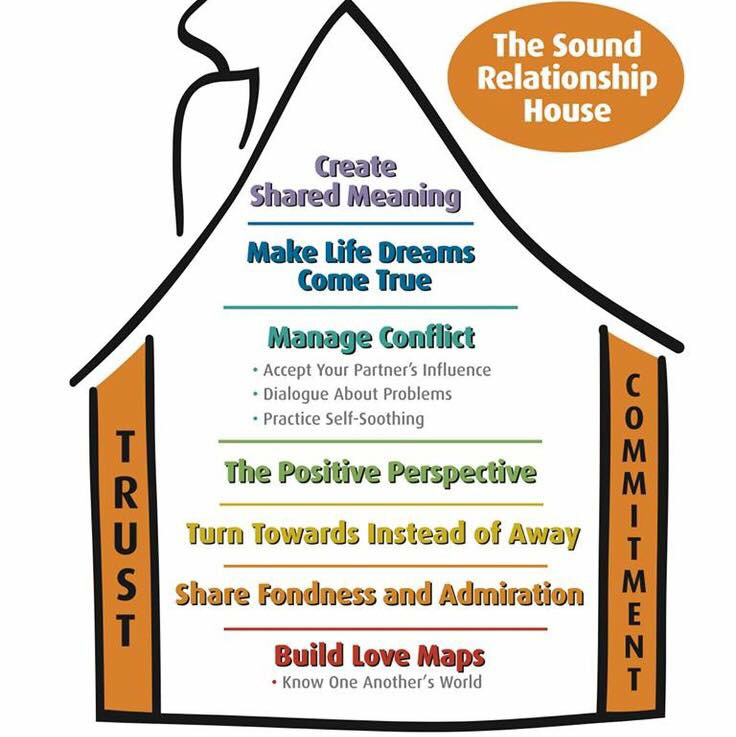
Gottman Method Couples Therapy
What is Gottman Method Couples Therapy?
Developed by Drs. John and Julie Gottman of The Gottman Institute, Gottman Method Couples Therapy is a research-based approach to strengthening relationships.
Dr. John Gottman has been studying relationships for decades, gaining insight about what makes relationships last. Over 3,000 couples participated in long-term research studies, which led to the development of one of the leading methods of couples therapy.
What are the goals of Gottman Method Couples Therapy?
-To increase respect, affection and closeness,
-Break through and resolve conflict when partners feel stuck,
-Generate greater understanding between partners,
-And keep conflict discussions calm.
How do we accomplish this?
Drs. Gottman developed “The Sound Relationship House” which includes the 9 components of a healthy relationship. A therapist who is trained in The Gottman Method can keep your therapeutic work on track by including activities in session which help your relationship in these areas:
Build Love Maps (or how well you know your partner’s inner world).
Share Fondness and Admiration (the antidotes to contempt).
Turn Towards (small moments of relationship bonding).
The Positive Perspective (maintain positive view of your partner even in times of conflict).
Manage Conflict (how to manage conflict even when there isn’t a clear resolution).
Make Life Dreams Come True (encourage the couple to share honestly about hopes, values and aspirations).
Create Shared Meaning (understand the important stories and dreams for your relationship).
Trust (creating a secure feeling in the relationship).
Commitment (believing and acting as committed life partners).
As a relationship therapist in Tampa, Florida
I’ve had the privilege of training with the Gottmans and have completed Gottman Method Couples Therapy Levels I and II. Depending on your needs, I blend Gottman Method, NVC Communication and Emotionally Focused Couples Therapy (EFT) to give your relationship the best chance of success!
Make an appointment: www.SouthTampaCounselor.com/BookAppointment

Top Rated Marriage Counselor In Tampa
I am honored to be among the top 3 rated marriage counselors in Tampa!
Thank you so very much for this recognition. I love what I do!

Feeling Honored and Passionate About Helping Couples & Families! ~Liz